 Delorion
Find and select users
Filter the Global User Table, select the correct accounts and save queries for repeated work.
Applies to userXpress 1.9.5.50
Before changing accounts, check the System and Client values. The same user ID can exist in several clients.
Filter and select
- In the Global User Table, enter a complete or partial value in the search/filter field for the relevant column.
- Add filters in other columns to narrow the result.
- Select the accounts you want to act on. Use Shift to select a range of rows.
- Check the highlighted rows and their system/client values before opening an action.
Use the table toolbar or right-click a selected row to open the available actions. Clearing a filter changes the visible result; it does not undo a completed SAP operation.
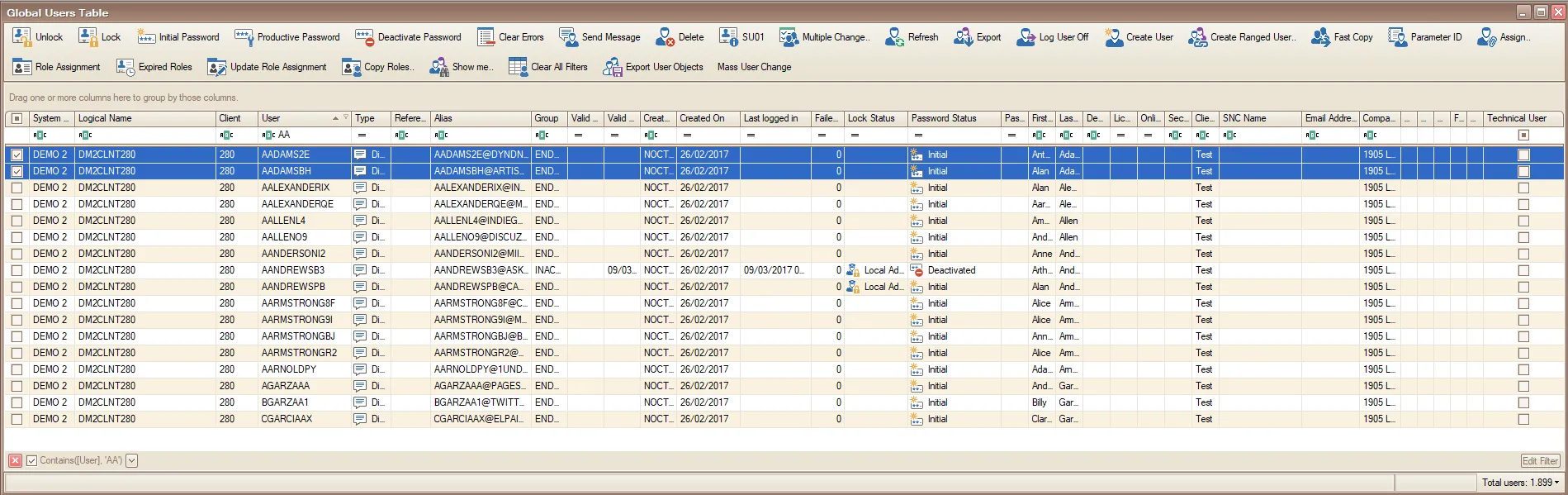
The filter narrows the list; the checked rows identify the accounts selected for an action.
Use a built-in query
Open Show Me and select the condition you need, such as users who have not logged on within a chosen period. The query filters the Global User Table. Review the resulting accounts before selecting an administration action.
Save a query
After setting the filters, choose My Queries → Save the current query.. and give the query a descriptive name. Saved queries let you apply the same filters again; their results depend on the data currently loaded.
Open My Queries → Maintain Queries to edit a query’s name or select it and choose Delete. Choose Save to retain the changes. Removing a saved query removes the filter definition, not the accounts it previously displayed.
Export the table
Use the Global User Table export action, choose the output format and save the file. Review the exported rows and columns before sharing it. Exports can contain account and personal information; store them according to your organization’s access rules.
Open the user in SAP
Select the account and use SU01, or double-click the user row, to open the user in SAP GUI. The toolbar action uses the first selected user, not the whole selection. This requires a working SAP GUI installation, a dialog-capable SAP logon and authorization in the selected client. A non-dialog account used for the connection cannot provide this interactive session. If SAP GUI does not open, check its installation and connection configuration before retrying.